


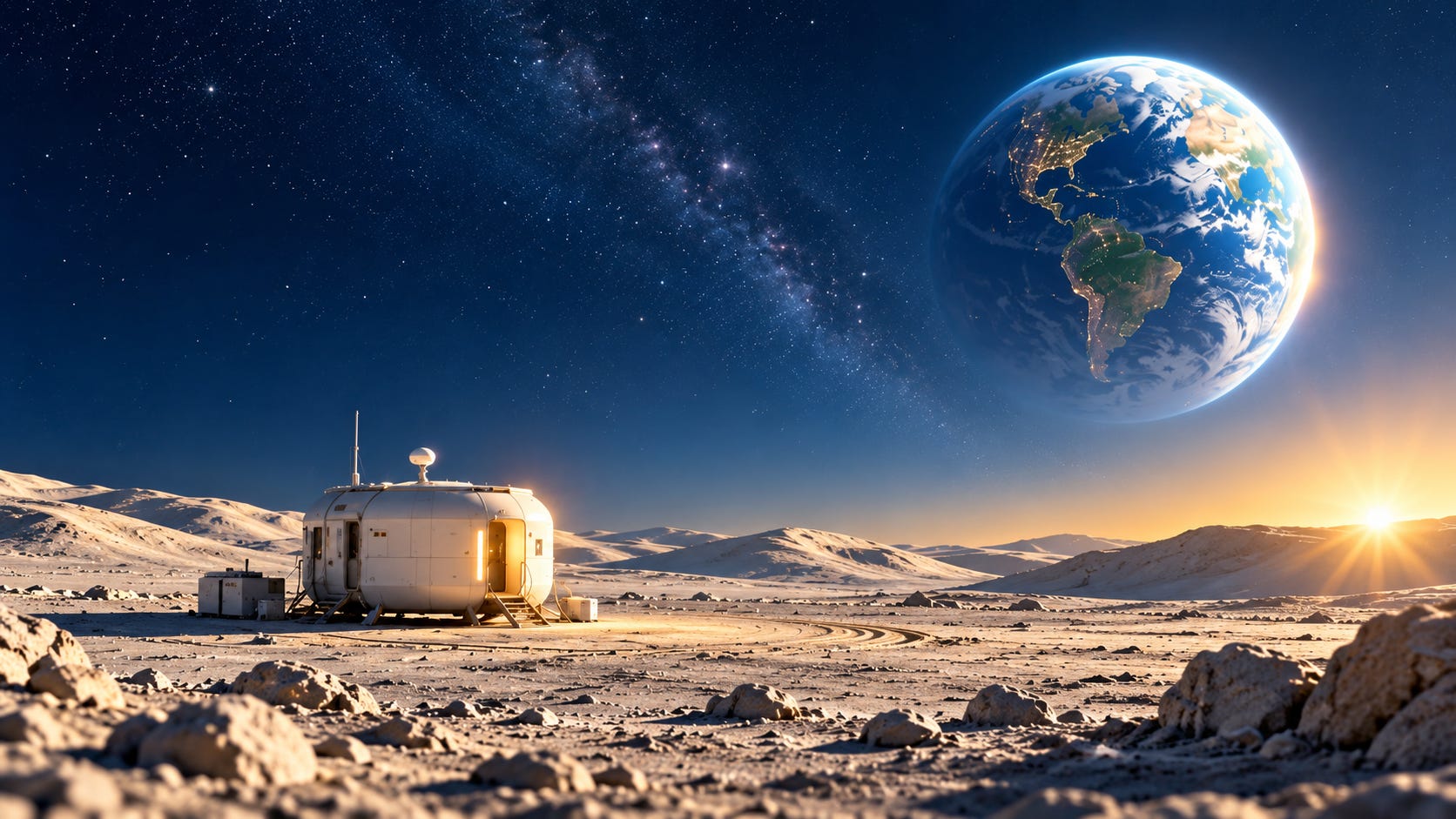
Look up at the Moon tonight.
For our entire lives, and for almost the whole history of humanity, it has been a distant object in the sky.
We have admired it, studied it, written poetry about it and even walked on it briefly. Then we came home.
That may be about to change.
At some point, the enormous spacecraft being developed by companies such as SpaceX and Blue Origin may evolve beyond exploration vehicles.
They could become space liners, first carrying machines and cargo, then scientists and workers, and eventually passengers.
Once transportation becomes regular enough, something remarkable becomes possible.
Humanity can begin building another place to live.
2035: One Pod
Imagine the year 2035. A large spacecraft descends toward the Moon carrying something different from anything delivered before: a settlement pod.
Not a flag or a temporary lander, but a place designed for people to stay.
Perhaps six people live there. Inside are sleeping quarters, communications systems, food, water recycling, oxygen equipment, medical supplies and a small laboratory.
Outside lies an enormous silence. No trees, roads or cities, and no other human beings for hundreds of thousands of kilometres.
Just one small settlement surrounded by the lunar landscape.
It may not look impressive, but historically it would be immense. Humanity would have established its first permanent foothold on another world.
2040: Four Pods
Then another pod arrives, followed by another and another.
By 2040, imagine three or four interconnected habitats.
One houses people, another contains laboratories, while others hold machinery, storage, power systems or experiments in extracting water, oxygen and useful material from the Moon itself.
The settlement is still tiny, but something important has happened.
It is no longer just a pod. It is becoming a community.
People work there, sleep there, eat there, repair things there and call their families on Earth from there. Every new piece of infrastructure also makes the next arrival a little easier.
2050: Twenty Pods
Now move forward another decade.
Twenty pods could begin to resemble something much more substantial.
There may be residences, laboratories, workshops, medical facilities, warehouses, power systems and garages for lunar vehicles.
Solar installations could spread across suitable terrain while robotic machines excavate lunar soil.
Water extraction might begin supporting life, fuel production and industry, while some construction material may no longer need to travel from Earth at all.
Scientists would be joined by engineers, technicians, physicians, construction specialists, communications workers and perhaps the first entrepreneurs.
Some people might stay for months, while others could remain for years. Perhaps more than one settlement would now exist.
Spacecraft might also begin arriving less as extraordinary missions and more as transportation. One lands with machinery, another with replacement crews, another with food, equipment and new habitat sections.
Slowly, the extraordinary becomes routine.
From Outpost to Settlement
The first lunar pod would be extraordinarily expensive. The twentieth should be easier, and the hundredth could be easier still, because infrastructure builds upon infrastructure.
Robots can prepare sites before people arrive.
Local material can provide radiation shielding, water can increasingly come from the Moon, power generation can expand and machines can manufacture more components locally.
Every capability established on the Moon reduces something that must be carried there from Earth.
That could create a powerful cycle.
More infrastructure makes settlement easier, easier settlement attracts more activity, more activity creates markets, and markets justify better transportation.
Better transportation then brings more people.
Somewhere along that progression, a remote outpost could begin becoming a town.
2075: A Lunar Society
Now imagine the Moon in 2075.
Not one pod and not twenty, but perhaps hundreds of habitat modules across several settlements, with 5,000, 10,000 or even 20,000 people living and working there at any particular time.
The largest settlement might contain several thousand residents. Habitat sections could be connected through pressurized corridors, while some facilities are buried beneath lunar material for protection.
Autonomous machines might operate mines, construction equipment and transport systems. There could be a proper hospital, research institutes, engineering companies, restaurants, gyms, hotels for visitors and places of worship.
Eventually, schools may appear too.
People would conduct business, complain about their jobs, fall in love and celebrate weddings. Children might grow up knowing Earth not only as home, but as that enormous blue world hanging in the black sky above them.
Spacecraft could travel between Earth and the Moon on published schedules, with passenger manifests, freight contracts, cargo terminals, departure times and tickets.
Perhaps someone in Toronto will one day say casually, “My daughter works on the Moon. She’ll be home next month.”
Think about how extraordinary that ordinary sentence would be.
Another World Becomes Part of Ours
The greatest transformation may not happen when the first spacecraft lands. It may happen decades later, when landing on the Moon stops being astonishing.
The Moon becomes somewhere people go, somewhere people work, somewhere companies operate and somewhere humanity builds.
For thousands of years, we looked upward and wondered what was out there. We may now be approaching the period when we begin moving into it.
One pod becomes four. Four become twenty. Twenty become hundreds.
An outpost becomes a settlement, and a settlement perhaps becomes a society.
Sometime in this century, almost without noticing the precise moment when it happened, humanity may look up at that familiar light in the night sky and realize something profound: A new world has opened up above us.
Give This to a Ten-Year-Old
Now think about a child who is 10 years old today.
In 2035, when the first permanent settlement pod may be appearing on the Moon, that child will be 19.
In 2050, when there could be twenty pods and the beginnings of a genuine lunar settlement, that child will be 35.
And in 2075, when the Moon may contain towns, businesses, thousands of residents and regular transportation from Earth, that same child will be 60.
This is not some unimaginably distant future. It could unfold within one human lifetime.
Also, given today’s research into extending lifespans and reversing biological aging, 60 in 2075 may be the new 30 for some.
Today’s ten-year-old may spend adulthood watching the Moon change from a light in the night sky into a place where people live, work, build companies, raise families and perhaps spend entire lives.
If you have a child around that age, and you want them to reach for the Moon, perhaps this is a story they should read now.
Because for the frontier visionaries, explorers and builders of their generation, the Moon may no longer be a distant dream.
It may be a destination.
AI disclosure
The ideas, framing and arguments are generally my own.
I use a paid, advanced frontier AI model to help develop, check and polish my work through multiple iterations. I review, edit and approve the final article.
The accompanying image was developed similarly.