


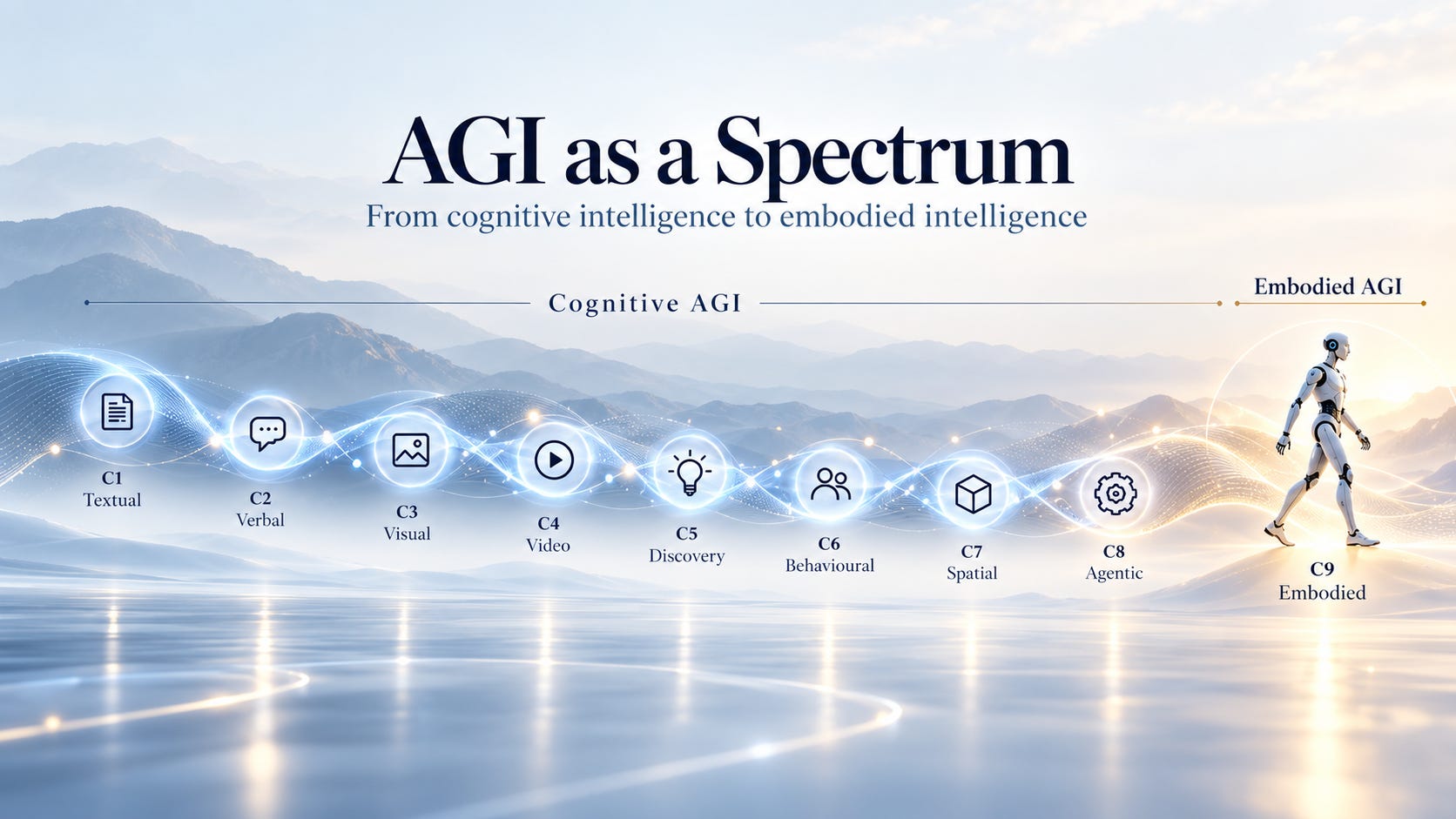
Artificial General Intelligence, AGI¹, can be understood simply as artificial intelligence capable of performing a broad range of activities at the level of capable human beings or relevant human experts.
Superintelligence, SI², is artificial intelligence whose capabilities extend far beyond that level.
The definitions sound simple. Applying them is more difficult.
An AI could reason like an accomplished scientist across several disciplines yet struggle to manage a complicated project over an extended period. It could design a sophisticated machine while lacking the physical ability to assemble it.
At what point should we say it has achieved AGI?
In my view, the answer depends on four things:
What capabilities it possesses.
How well it performs.
How effectively it remembers.
How long it can operate independently.
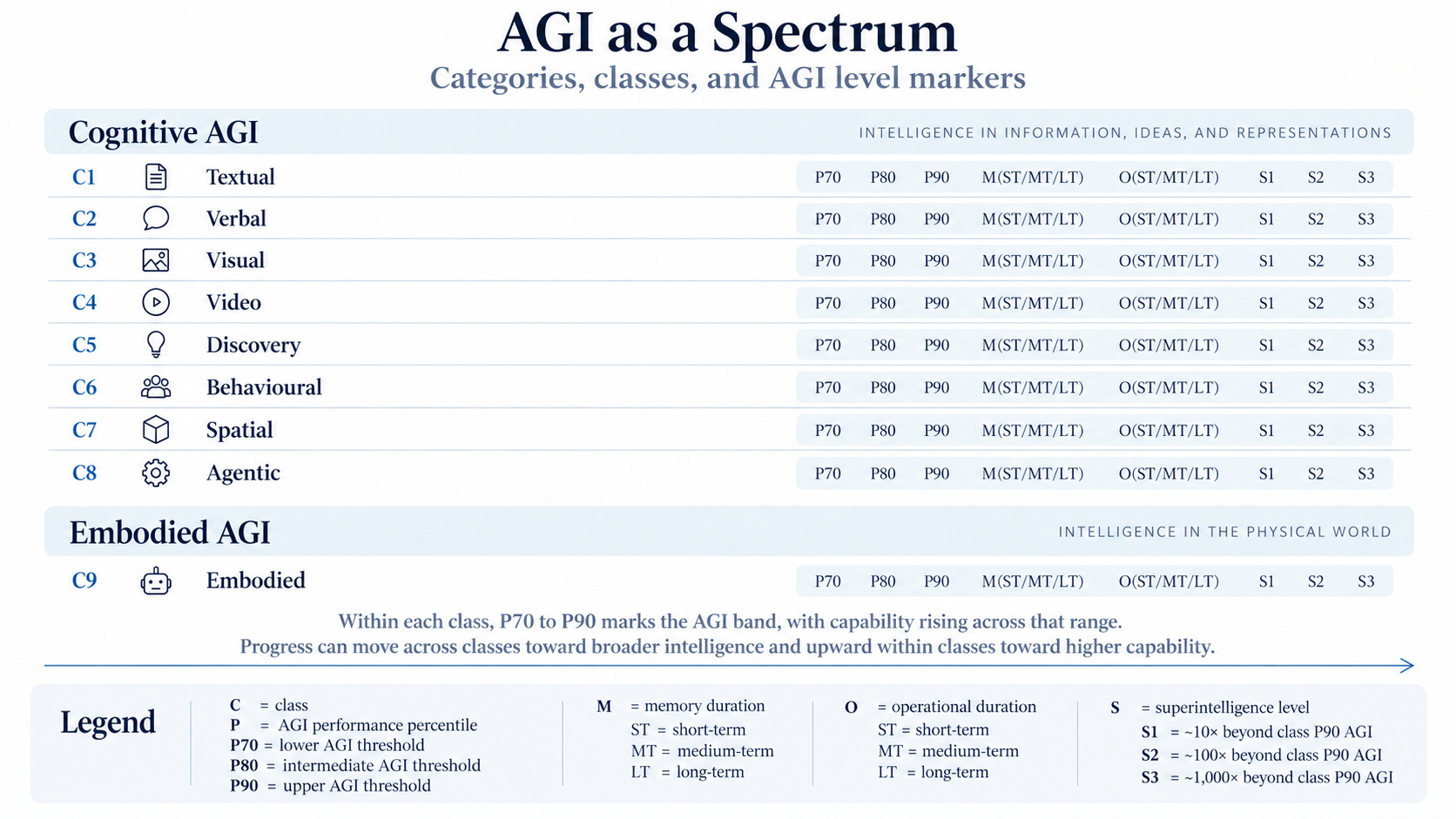
I therefore propose a framework of two categories and nine cumulative classes³, assessed through percentile performance, memory, operational duration, and super intelligence.
Part I
Two Categories and Nine Classes of AGI
I propose organizing AGI into two broad categories.
Category 1
Cognitive AGI
Cognitive AGI covers knowledge, reasoning, communication, creativity, discovery, social understanding, spatial understanding and agentic AI.
It contains eight classes:
Textual AGI
Verbal AGI
Visual AGI
Video AGI
Creative and Discovery AGI
Social and Behavioural AGI
Spatial AGI
Agentic
Category 2
Embodied AGI
Embodied AGI extends the cognitive foundation into autonomous action and physical capability.
It contains one class:
Motor and Embodied AGI
Note
One rule connects the classes: each higher class includes the capabilities of all preceding classes and adds another capability.
I call this the cumulative rule⁴.
This is a proposed classification, not a prediction that AI development will follow this exact sequence. Individual capabilities may advance unevenly. The cumulative rule determines which complete class a system can claim under the framework.
Category 1:
Cognitive AGI
Class 1
Textual AGI
Capabilities: Textual intelligence
Textual AGI operates across mathematics, physics, medicine, engineering, computer science, law, economics, history, philosophy, business, and other major fields of knowledge.
It includes:
Comprehension.
Reasoning.
Analysis.
Synthesis.
Problem-solving.
Written articulation.
The AI does more than retrieve information. It applies knowledge, connects ideas across disciplines, examines arguments, evaluates evidence, solves problems, and clearly explains its conclusions.
Class 2
Verbal AGI
Capabilities: Textual and verbal intelligence
Verbal AGI adds spoken comprehension and articulation.
It understands speech, tone, nuance, arguments, questions, instructions, and conversational context.
It can explain, teach, discuss, interview, negotiate, persuade, and adapt its communication to different people and circumstances.
A Class 2 system therefore possesses the textual capabilities of Class 1 together with advanced verbal capability.
Class 3
Visual AGI
Capabilities: Textual, verbal, and visual intelligence
Visual AGI adds the ability to understand and create visual information, including:
Photographs.
Diagrams and charts.
Designs and illustrations.
Technical drawings.
Medical images.
Scientific visualizations.
The appropriate standard depends on the activity.
Medical images require clinical evaluation. Engineering drawings must satisfy engineering requirements. Visual designs should be evaluated according to their intended artistic or functional purpose.
Class 4
Video AGI
Capabilities: Textual, verbal, visual, and video intelligence
Video AGI adds the ability to understand and create moving images.
It comprehends movement, behaviour, demonstrations, processes, events, and sequences over time. It can analyze relationships between events and reason about possible causes.
It must also recognize the limits of the evidence. Seeing two events occur in sequence does not necessarily establish that one caused the other.
Class 5
Creative and Discovery AGI
Capabilities: Previous classes plus creativity and discovery
This class adds the ability to generate valuable new ideas and develop solutions to previously unsolved problems.
Its contributions could include:
Inventions.
Hypotheses and theories.
Strategies.
Designs and engineering solutions.
Mathematical approaches.
Scientific discoveries.
Business concepts.
Novelty alone is insufficient. Producing something nobody has said before does not automatically constitute meaningful discovery.
A proposed discovery must withstand the appropriate evaluation, whether through evidence, experimentation, expert review, mathematical proof, engineering validation, commercial testing, or another suitable method.
Class 6
Social and Behavioral AGI
Capabilities: Previous classes plus social and behavioural understanding
This class adds sophisticated understanding of people.
It interprets:
Emotions.
Intentions.
Relationships.
Incentives.
Communication.
Group behaviour.
Social dynamics.
It can apply this understanding to teaching, negotiation, persuasion, leadership, cooperation, conflict resolution, and collective decision-making.
Such capability also requires restraint. Human thoughts and motives are not directly observable. A capable system should distinguish what the evidence establishes from what it merely suggests.
Class 7
Spatial AGI
Capabilities: Previous classes plus spatial intelligence
Spatial AGI adds a comprehensive understanding of physical space.
This includes:
Three-dimensional objects.
Dimensions and orientation.
Distance and movement.
Trajectories.
Environments.
Spatial relationships.
Physical consequences.
It can reason about how objects relate to one another, whether they fit together, how they move, where they may collide, and how changing one object affects another.
It can also apply this reasoning in unfamiliar environments.
Spatial understanding does not, by itself, establish the physical ability to act on that understanding. That capability appears in Class 9.
Class 8
Agentic AGI
Capabilities: All seven cognitive classes plus autonomous action
Agentic AGI extends understanding and communication into sustained independent action.
Given an objective, it can:
Develop a plan and conduct research.
Operate software and use tools.
Communicate with people or systems.
Make decisions.
Monitor progress.
Detect mistakes.
Revise its approach.
Continue working toward completion.
This introduces another dimension: operational duration.
An impressive beginning is insufficient. The system must maintain progress, respond appropriately when something goes wrong, and reliably carry complicated work through to completion.
Agentic capability should therefore be assessed according to both performance quality and the duration over which that performance can be sustained.
Category 2
Embodied AGI
Class 9
Motor and Embodied AGI
Capabilities: Previous classes plus physical capability through robotics
Motor and Embodied AGI brings intelligence into physical action.
The system can:
Navigate environments.
Manipulate objects.
Use physical tools.
Coordinate movement.
Perform skilled work.
Learn new motor activities.
Adapt physically to changing circumstances.
Here, the intelligence and robotic body must be assessed together.
Explaining how to perform a surgical procedure, repair job, sporting movement, manufacturing task, or household activity is insufficient.
The system must possess the perception, coordination, control, precision, and adaptability necessary to perform the activity itself.
Why the Classes Matter
This framework helps explain why debates about AGI can become confused.
One person says, “AGI has arrived.”
Another says, “We are nowhere near AGI.”
They may be evaluating different capabilities. One may be thinking primarily about Class 5. Another may require Class 8. A third may consider AGI incomplete until Class 9 has been achieved.
Stating the class makes the disagreement easier to understand.
The question becomes more precise:
Which class of AGI has been achieved, and at what level of performance?
Part II
Measuring Capability Within Each Class
The classes describe the range of things an AI can do. They do not, by themselves, establish how well it performs or whether it has reached the proposed AGI threshold.
Progress can occur in two directions.
An AI can advance across classes, acquiring a broader range of capabilities. It can also improve within a class, becoming more capable at activities it already performs.
I propose assessing each class through four dimensions:
Percentile performance.
Memory.
Operational duration, where applicable.
Superintelligence.
Each dimension can be expressed through a simple code.
Percentile Performance⁵
Percentile performance describes how well an AI performs relative to an appropriate group of human experts.
P70
Performance at or above the 70th percentile of the relevant human expert group.
P80
Performance at or above the 80th percentile of the relevant human expert group.
P90
Performance at or above the 90th percentile of the relevant human expert group.
The reported level is the highest of these thresholds consistently demonstrated across the capabilities required for the class.
In this framework, P70 is the lower threshold for AGI within a class, P80 is the intermediate level, and P90 is the upper threshold.
A system can therefore be assessed against a class before reaching that class’s AGI threshold.
P80 does not mean 80% accuracy. It means performance at or above approximately 80% of the relevant comparison group.
That group must match the activity. The appropriate experts for mathematical reasoning differ from those for medical diagnosis, negotiation, visual design, mechanical repair, scientific research, or robotic manipulation.
A percentile designation is meaningful only when the comparison group, tasks, and testing conditions are clearly defined.
Memory⁶
Memory should be assessed across all nine classes.
It describes how effectively an AI can:
Retain information.
Retrieve it.
Connect it.
Prioritize it.
Update it.
Apply it appropriately.
This includes preserving context, incorporating corrections, distinguishing current information from obsolete information, and recognizing which past information matters to the present task.
I propose three memory levels.
Short-Term Memory, STM
The AI retains and uses information within an immediate conversation, exchange, task, or closely connected sequence of tasks.
Mid-Term Memory, MTM
The AI preserves and applies relevant context across related tasks and throughout an ongoing project.
Long-Term Memory, LTM
The AI maintains, retrieves, connects, updates, and appropriately applies information across projects and extended periods.
Memory should be assessed through both retention and quality of use.
LTM has limited value if the AI remembers information inaccurately, cannot retrieve it when needed, or applies it in the wrong situation.
Operational Duration⁷
Operational duration becomes particularly relevant from Class 8, Agentic AGI, onward.
It describes how long an AI can sustain autonomous work at its stated performance level.
I propose three operational levels.
Short-Term Operation, STO
The AI independently pursues a bounded objective over a relatively short period while maintaining the required performance.
Mid-Term Operation, MTO
The AI sustains autonomous work across multiple coordinated tasks while preserving context, monitoring progress, responding to problems, and correcting errors.
Long-Term Operation, LTO
The AI autonomously pursues objectives over extended periods, adapts to changing circumstances, manages interruptions, preserves continuity, and appropriately resumes work.
These are conceptual bands. Any assessment should state the actual duration demonstrated, the demands of the work, and the amount of human intervention permitted.
Operational duration is distinct from memory.
An AI could possess LTM while remaining capable of only STO. Another system could sustain LTO while operating at a lower percentile performance level.
Performance, memory, and operational duration must therefore be assessed separately.
Beyond AGI: Super Intelligence
Super intelligence, SI, need not emerge across every capability at once.
An AI might become superintelligent in mathematics, coding, scientific discovery, or engineering while remaining much weaker in social understanding, autonomous operation, spatial reasoning, or physical activity.
Using P90 performance among relevant human experts as the reference AGI capability⁸, I propose three conceptual superintelligence markers.
SI1
Approximately 10 times the reference AGI capability within a specified, meaningfully measurable activity.
SI1 represents substantial capability beyond the proposed human expert reference.
SI2
Approximately 100 times the reference AGI capability, or roughly ten times SI1 on the same measure.
SI2 represents a much greater scale of measurable performance.
SI3
Approximately 1,000 times the reference AGI capability, or roughly ten times SI2 on the same measure.
SI3 represents capability enormously beyond the human expert reference.
These multipliers are conceptual markers. Intelligence has no single universal numerical unit that can simply be multiplied.
Any SI claim would therefore need to identify exactly what is being measured and why a tenfold, hundredfold, or thousandfold comparison is meaningful.
A measure of productivity, for example, would describe a different achievement from a measure of solution quality. Neither should automatically be treated as a universal measure of intelligence.
Narrow SI and Wide SI
Super intelligence in one class does not establish super intelligence across the entire set of classes.
An AI might demonstrate SI1 in class 1 without reaching SI1 across the other classes.
Exceptional video performance would likewise be insufficient to establish SI in embodied intelligence.
A general SI designation would require the stated level across the cumulative capabilities represented by all classes, using appropriate measures for each.
Scope must therefore accompany the claim.
“SI1 in text” is a narrower designation than “Class 7 SI1.” Both could describe substantial achievements, but they describe different achievements.
Applying the Framework
The framework allows an AI system’s demonstrated capabilities to be expressed through compact notation:
Class · Performance · Memory · Operational Duration
Operational duration is included when assessing the operational classes.
In these codes,
C denotes class,
P denotes percentile performance,
M denotes memory,
O denotes operational duration, and
SI denotes superintelligence.
Consider three examples.
C4 · P60 · MTM
The system demonstrates textual, verbal, visual, and video capabilities at P60 or lower, with Mid-Term Memory.
It has reached the P60 marker across Class 4’s cumulative capabilities. It has not yet demonstrated the proposed P70 threshold for Class 4 AGI.
C8 · P70 · LTM · MTO
The system demonstrates all seven cognitive classes and agentic AGI capability at P70 or higher, with Long-Term Memory and Mid-Term Operation.
It therefore meets the proposed AGI threshold through Class 8.
C7 · SI1 · LTM
The system demonstrates SI1 across the cumulative capabilities of Classes 1 through 7, using appropriate measures for each, and possesses Long-Term Memory.
This designation does not establish its standing in Classes 8 or 9. Those capabilities require separate assessment.
The same system could, for example, qualify at C7 · SI1 · LTM and C8 · P90 · LTM · MTO. Its first seven classes of cognitive capabilities would have advanced into SI1 while its agentic capability remained at the proposed AGI threshold.
The cumulative rule remains essential.
A C4 · P80 claim requires P80 or higher across textual, verbal, visual, and video capabilities.
A C8 · P90 · LTM · MTO claim requires P90 or higher across all seven cognitive classes and agentic capability, together with demonstrated Long-Term Memory and Mid-Term Operation.
A system that falls short of a cumulative class designation may still possess exceptional individual capabilities. Those achievements should be recognized through narrower, accurately scoped, exceptional and specified descriptions.
A Better Way to Ask Whether AGI Has Arrived
Instead of asking only, “Have we achieved AGI?”, I suggest asking five questions:
Which class has been demonstrated?
At what performance level: P70, P80, or the proposed AGI threshold of P90?
What memory level has been demonstrated: STM, MTM, or LTM?
For operational classes, what duration of autonomous operation has been demonstrated: STO, MTO, or LTO?
Has any capability or complete class advanced into SI1, SI2, or SI3?
These questions produce a more precise description of progress.
An AI could possess extraordinary intellectual ability while lacking sustained autonomy. It could understand physical tasks while lacking the robotic dexterity to perform them. It could become superintelligent in individual domains while remaining considerably weaker elsewhere.
Under this framework, achieving AGI within one class does not establish AGI across every class.
AGI can therefore be understood as a progression across categories, classes, performance, memory, operational duration, and superintelligence.
This vocabulary allows us to recognize substantial achievements while stating clearly what has been demonstrated and what remains to be achieved.
Terminology
¹ Artificial General Intelligence, AGI
Artificial intelligence capable of performing a broad range of activities at the level of capable human beings or relevant human experts.
Within this proposed framework, P70 is the threshold for an AGI designation within a class.
² Superintelligence, SI
Artificial intelligence whose demonstrated capability extends far beyond the relevant human expert reference.
³ Class, C
A defined range of capabilities an AI can perform.
The class number identifies breadth of capability. The separate performance code identifies proficiency.
⁴ Cumulative Rule
The principle that each higher class includes the capabilities required by all preceding classes and adds another capability.
A cumulative performance designation requires the stated threshold across the capabilities included in that class.
⁵ Percentile Performance, P
A comparison between an AI’s performance and that of an appropriate group of human experts.
P70, P80, and P90 identify the 70th, 80th, and 90th percentile thresholds respectively. They do not represent percentages of accuracy.
⁶ Memory, M
The ability to retain, retrieve, connect, update, prioritize, and appropriately apply information over time.
STM: Short-Term Memory.
MTM: Mid-Term Memory.
LTM: Long-Term Memory.
⁷ Operational Duration, O
The duration over which an AI can sustain autonomous work while maintaining its stated level of performance.
STO: Short-Term Operation.
MTO: Mid-Term Operation.
LTO: Long-Term Operation.
⁸ Reference AGI Capability
P90 performance among the relevant human expert group, used here as the conceptual reference for superintelligence comparisons.
On an appropriate, explicitly defined measure:
SI1: Approximately 10 times the reference AGI capability.
SI2: Approximately 100 times the reference AGI capability.
SI3: Approximately 1,000 times the reference AGI capability.
A Note on the Framework
The classes, percentile thresholds, memory levels, operational levels, and SI multipliers proposed here are conceptual conventions. They are not scientifically established measurements of intelligence.
Testing the framework would require clearly defined tasks, appropriate human comparison groups, reproducible evaluation methods, and explicit conditions concerning tools, assistance, and human intervention.
SI comparisons would also require measures for which tenfold, hundredfold, or thousandfold improvements have meaningful interpretations. Percentile rankings themselves cannot be multiplied to produce measurements of intelligence.
My purpose is to offer a clearer vocabulary for discussing increasingly capable AI: what it can do, how well it can do it, what it can remember, and how long it can work independently.
AI disclosure:
The ideas, framing and arguments are generally my own.
I use a paid, advanced frontier AI model to help develop, check and polish my work through multiple iterations. I review, edit and approve the final article.
The accompanying image was developed similarly.