


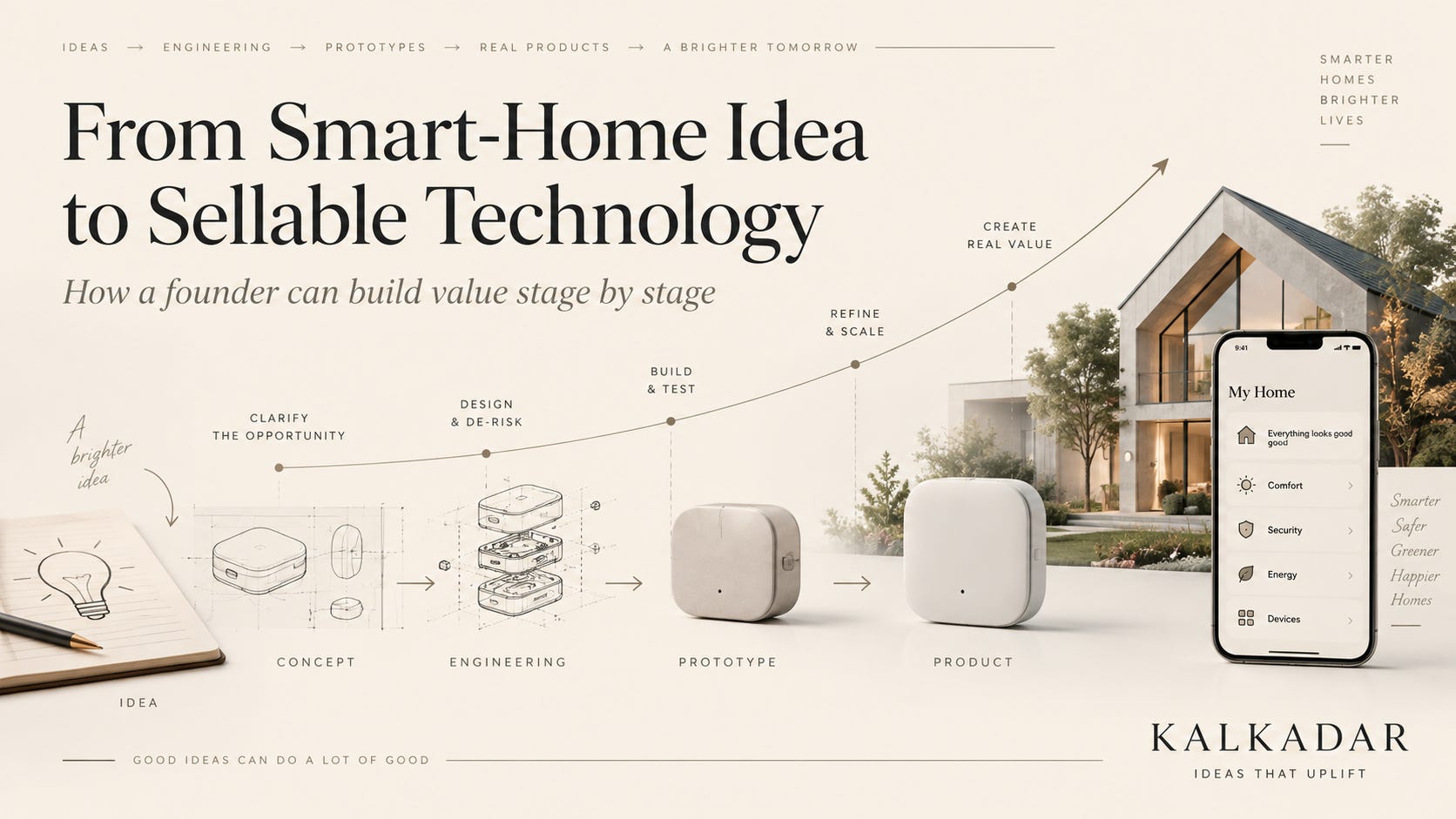
This is a companion to my earlier article, “A Consumer Technology Opportunity.”
How a Founder Can Use an Engineering Consultancy to Build Value, Stage by Stage
Suppose you have an idea for a new smart-home electronic product, but you are not an electrical engineer, firmware developer, industrial designer or software engineer.
Instead of first building an engineering team, a founder can hire a product-development consultancy to develop the idea stage by stage.
At any stage, the venture may continue development, raise capital, license the technology or be sold.
If it later moves toward production, an in-house engineering team can be built, potentially with compensation including salary and equity.
Development Stages
A smart-home electronic product typically progresses through:
Idea → product definition → feasibility → proof of concept → prototype → validation → MVP + pilot → production-ready product
Each stage can create more certainty and make the opportunity more attractive to investors, strategic partners and buyers.
From Early Definition to Commercial Readiness
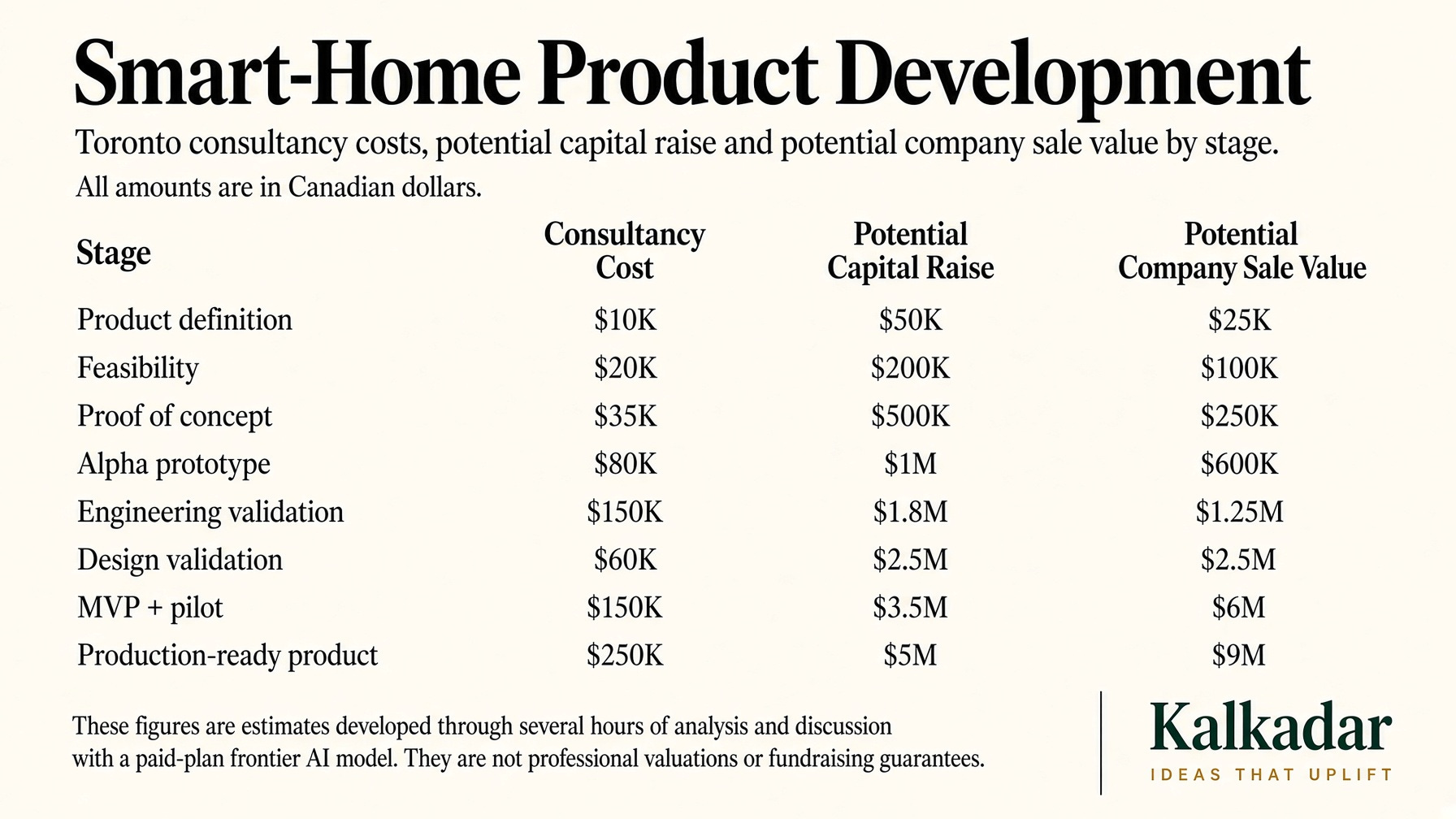
The chart below shows Toronto consultancy costs, potential capital raises after each stage, and potential sale values for Affan’s specific smart-home electronic product.
How the Development Stages Work
The chart provides the big picture.
What follows briefly explains what happens at each stage, what the consultancy delivers, and the cost, capital-raising potential and sale value.
Each stage can be commissioned separately. After completing it, the founder can continue developing, raise capital, partner, license or sell.
1. Product Definition
The consultancy turns the founder’s idea into an engineering plan:
what the product should do
how it might work
what must be developed
Typical deliverables include a
Product Requirements Document
preliminary architecture and development roadmap
Consultancy cost: about $10,000
Potential capital raise: about $50,000
Potential sale value: about $25,000
At this point, an idea has become a defined product opportunity.
2. Feasibility Study
Engineers investigate the technologies that could make the product work and test the most promising approaches.
The founder receives
technical findings
recommended architecture
preliminary components
a path toward a proof of concept
Consultancy cost: about $20,000
Potential capital raise: about $200,000
Potential sale value: about $100,000
The opportunity now has professional engineering evidence behind it.
3. Proof of Concept
The consultancy builds a simple experimental system demonstrating the product’s central capability.
A proof of concept may be crude. What matters is that the technology works.
Consultancy cost: about $35,000
Potential capital raise: about $500,000
Potential sale value: about $250,000
At this point, the conversation changes from “Here is the idea” to “Here it is working.”
4. Alpha Prototype
The technology begins becoming a recognizable product.
Custom electronics
firmware
connectivity
an enclosure and basic software can be integrated into one working system
Consultancy cost: about $80,000
Potential capital raise: about $1 million
Potential sale value: about $600,000
Investors and potential buyers can now see, hold and evaluate the emerging product.
5. Engineering Validation
Multiple units are built and tested to demonstrate consistent performance.
The founder begins accumulating
reliability data
refined designs
stronger technical documentation
Consultancy cost: about $150,000
Potential capital raise: about $1.8 million
Potential sale value: about $1.25 million
The technology is becoming a more substantial business asset.
6. Design Validation
The product is refined toward
commercial manufacture
certification and
repeatable production
Consultancy cost: about $60,000
Potential capital raise: about $2.5 million
Potential sale value: about $2.5 million
The project increasingly resembles a commercially transferable product platform.
7. MVP and Household Pilot
Working devices are placed in real homes.
Now the founder can demonstrate that
the technology works
people can use it
people may want it
Consultancy cost: about $150,000
Potential capital raise: about $3.5 million
Potential sale value: about $6 million
Technical evidence is now joined by early market evidence.
8. Production-Ready Product
The consultancy prepares the product for
manufacturing
production engineering
testing
certification
manufacturing transfer
Consultancy cost: about $250,000
Potential capital raise: about $5 million
Potential sale value: about $9 million
The founder may now possess a technology and product package that an established company could manufacture and commercialize.
Capital Raise and Sale Value Are Different
A capital raise brings investment into the company in exchange for ownership.
A sale transfers the company, technology or intellectual property to a buyer.
The figures above are illustrative possibilities, not professional valuations or fundraising forecasts.
What Kinds of Smart-Home Products?
The same development path could apply to:
intelligent household sensors
safety and security devices
energy-management products
environmental monitors
aging-at-home technologies
smart appliances and accessories
home-wellness products
privacy-conscious automation
The underlying technologies might include radar, infrared, thermal sensing, ultrasound, Bluetooth, Wi-Fi, ultra-wideband, Matter, Thread or artificial intelligence.
The founder does not need to know the final technical solution at the beginning. Finding it can be part of the consultancy’s job.
Who Might Invest?
Early stages may attract
founders
friends and family
angel investors
accelerators
government innovation programs
As the technology matures, possibilities expand to
seed funds
hardware investors
deep-tech investors
corporate venture groups
strategic industry investors
Each successful stage gives investors more to evaluate.
Who Might Buy the Smart-Home Technology?
Potential buyers include:
smart-home companies
consumer-electronics manufacturers
appliance manufacturers
sensor and semiconductor companies
home-security businesses
telecommunications providers
building-automation companies
energy companies
original equipment manufacturers
These companies may already have manufacturing, distribution, software, marketing and customers.
The founder may bring them something they do not yet have: a developed technology and a new product opportunity.
Sell, License, Partner or Keep Building
The founder does not have to follow one predetermined path.
At any stage, the choices could include:
Sell
License
Raise capital
Find a strategic partner
Keep building
A licensing deal could potentially combine an upfront payment with royalties.
Each development stage creates another decision point.
Protect What Is Being Built
The consultancy agreement should clearly establish ownership of the resulting:
hardware designs
firmware
software
algorithms
prototypes
test data
documentation
patentable inventions
If the technology may eventually be financed, licensed or sold, clear ownership matters.
Three Toronto Consultancies to Explore
The following three Toronto-area firms were identified by a paid-plan frontier AI model as potentially suitable for Affan’s smart-home product.
The selection is based on their published capabilities and the project’s current needs.
They are examples for further investigation, not endorsements based on direct experience.
NeuronicWorks
Toronto-based product-development and manufacturing company covering electronics, firmware, software, mechanical design, prototyping, certification and manufacturing.
Radiocord Technologies
Toronto engineering firm offering feasibility studies, proofs of concept, hardware, firmware, IoT development, validation, pilots and manufacturing support.
Inertia Product Development
Toronto product-development company covering strategy, industrial design, electronics, embedded software, prototyping, validation and manufacturing readiness.
These are examples to investigate, not endorsements.
The Larger Opportunity
The progression is straightforward:
Idea → definition → feasibility → proof → prototype → validation → pilot → production
At every successful stage, more certainty is created.
And with greater certainty can come more credibility, more financing possibilities, more strategic options and potentially more value.
A founder does not necessarily have to build the entire consumer-electronics company.
Sometimes the opportunity is to build the technology far enough that someone else wants to finance it, license it, partner on it, or buy it.
AI disclosure:
The ideas, framing and arguments are my own.
I use a paid, advanced frontier AI model to help develop, check and polish my work through multiple iterations.
I review, edit and approve the final article.
The accompanying images were developed similarly.