


Hyderabad Must Plan in Centuries
Hyderabad is not an emerging settlement seeking identity.
It is an ancient, historic city that has endured kingdoms, empires, princely rule, modern India, state formation, technological advancement, and rapid urban expansion.
A city of such depth and resilience must think beyond election cycles. It should plan in generations and centuries.
The Hyderabad of the next 100 to 200 years is being shaped by decisions made today.
Every building permission, lake protected, public ground preserved, footpath reclaimed, and tree planted will determine that future.
Land once lost is rarely recovered.
A responsible city does not wait until open space disappears before asking where its children will play.
It safeguards space proactively and asks not only how many towers can be built, but how human beings will live meaningfully between them.
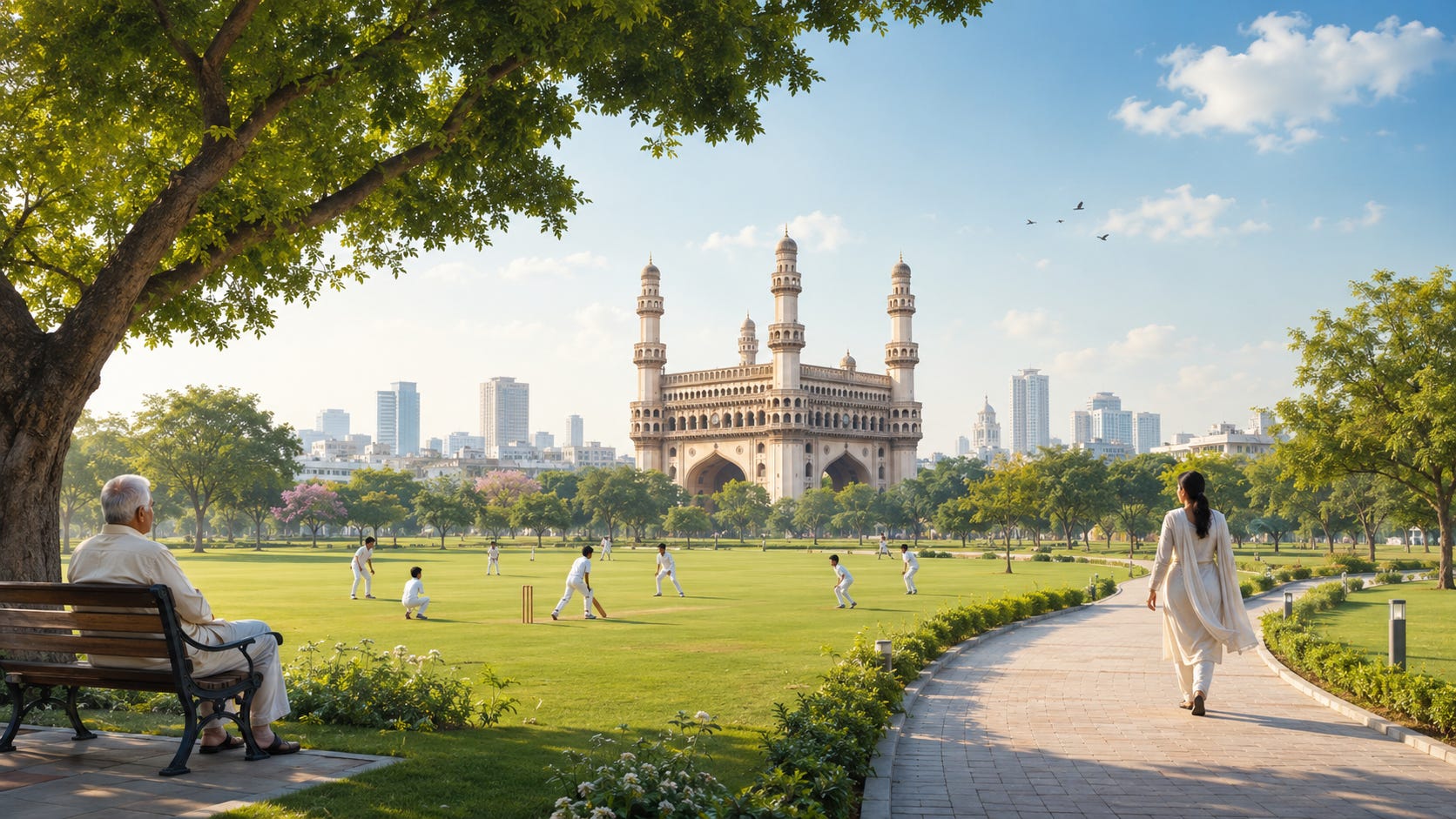
A Standard for Every Locality
Hyderabad should adopt a bold, long-term standard.
Every locality must ultimately provide all residents—including its poorest—with reliable access to clean air, open grounds, sport facilities, swimming pools, trees, walking areas, children’s play spaces, women-friendly public areas, senior-friendly zones, and community gathering places.
While implementation will vary according to context—an old, dense neighborhood cannot mirror a newly planned township—the guiding principle must be consistent: urban planning must centre on human health and dignity.
Every child deserves a place to play.
Every woman needs a safe place to walk.
Every senior requires comfortable seating and mobility.
Every family benefits from gathering spaces.
Every young person should have access to sport.
Where feasible, localities should aim for a full-sized cricket ground, two football fields, a swimming pool with free or subsidised lessons for children, walking tracks, shaded seating, safe play areas, and dedicated recreation spaces.
This is not an immediate pledge but a clear civic vision and planning north star.
Public Grounds Are Public Health
Public grounds, swimming pools, trees, walking areas, and safe recreation spaces are vital public health infrastructure, not decorative extras.
Roads facilitate movement, schools deliver education, and hospitals treat illness—yet open spaces prevent sickness, weakness, loneliness, and despair before they become crises.
Hyderabad must therefore treat public space with the seriousness it demands.
What Sport Delivers to Children
Sport equips children with essential skills and protects their development.
Cricket builds patience, teamwork, courage, and discipline.
Football develops stamina, cooperation, and resilience.
Swimming instils confidence, safety awareness, health, and strength.
These activities provide structure, energy, friendship, and constructive use of time, teaching young people how to win, lose, persist, and improve.
For many, sport serves as a safeguard against idleness, negative influences, addiction, anger, and despair.
A public ground functions as a school without walls.
What Open Space Provides to Communities
Safe, accessible open spaces strengthen the social fabric.
Women gain health, independence, and dignity through secure walking areas.
Seniors benefit from mobility, social connection, and renewal via shaded paths and seating.
Families experience belonging in clean gathering places.
A city that offers beauty earns loyalty and civic pride.
Collectively, open spaces enhance physical and mental health, youth development, women’s wellbeing, family life, community cohesion, productivity, and the urban image.
A city without room to breathe becomes one without space to dream.