


Article One of Four
A great society is not judged only by the lifestyles of its rich and famous people.
A great society is judged by how well its poorest children, women, and elderly can live healthy, dignified, and quality lives.
Too often, in a crowded Hyderabad locality, a child grows up between walls, traffic, noise, heat, and dust.
For most children in such areas, there is no ground.
No swimming pool.
No trees.
No shaded walking space.
No safe place to exercise.
No proper place to play cricket or football.
No clean public space where a child can run, fall, laugh, learn discipline, make friends, and grow strong.
This is how millions of children grow up in many Indian cities. Their bodies are young, their energy is alive, their minds are ready, but the city gives them no room.
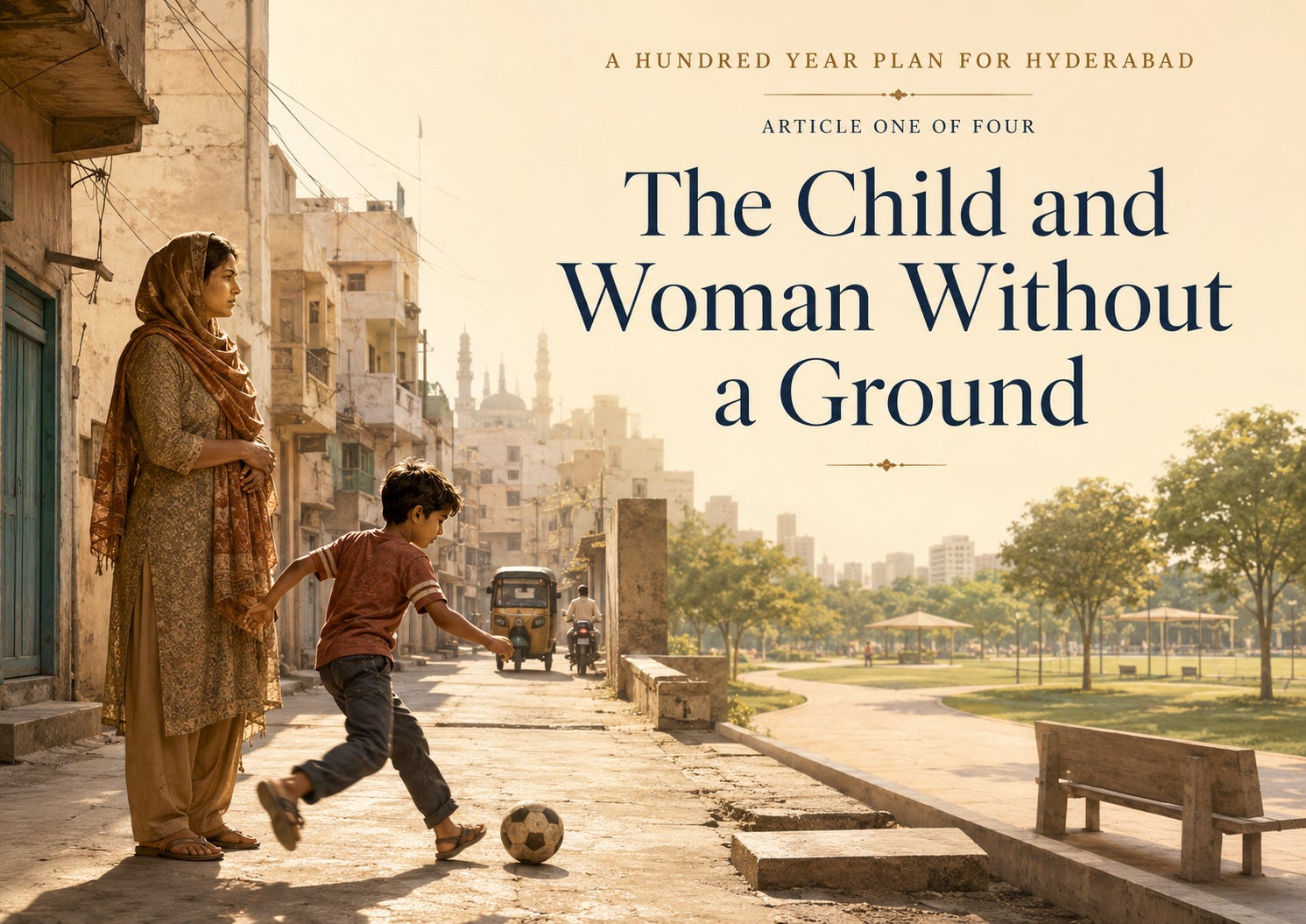
A poor child should not need wealth to breathe.
A poor child should not need a private school campus to play.
A poor child should not need a club membership to swim.
A poor child should not need to live in a gated community to see trees, walk safely, or enjoy beauty.
In the same locality, a woman steps out of her home and finds no peaceful place to walk.
No shaded bench.
No safe path.
No reliable space where she can exercise with comfort and dignity.
An elderly man wants to walk for his health, but the street is broken and crowded.
A grandmother wants to sit under a tree, but there is no tree.
A teenage boy turns the road into his playing field.
A teenage girl wants recreation, confidence, health, and fresh air, but the city has not planned enough space for her.
This is not only an urban planning problem.
It is a moral problem.
It is a public health problem.
It is a question of what kind of city Hyderabad wants to become.
What the Wealthy Already Have
The wealthy already understand the value of space.
Their children study in schools with campuses, grounds, courts, swimming pools, trees, and clean walkways.
Their families use private clubs, sports academies, gated communities, gyms, gardens, and pools.
They can pay for cricket coaching, football coaching, swimming classes, fitness programs, weekend recreation, and safe family outings.
They can buy what the city has not provided.
The poor cannot.
That is why public planning matters.
A great society is not judged only by the lifestyles of its rich and famous people.
A great society is judged by how well its poorest children, women, and elderly can live healthy, dignified, and quality lives.
This is not a demand for luxury.
It is a demand for quality.
It is a demand for public health.
It is a demand that even the poorest should have the basic conditions needed for human growth.
The Real Question
Hyderabad is an old and powerful city.
It has history, culture, talent, ambition, technology, money, and influence.
But the real test of a city is not only its skyline.
It is not only its flyovers, towers, malls, airports, and software parks.
The real test is the life of the ordinary child.
Can that child play?
Can that child breathe?
Can that child learn sport?
Can that child swim?
Can that child see trees?
Can that child grow up with health, confidence, and dignity?
The same question applies to women, seniors, families, and youth.
A city that forgets them may grow rich, but it does not become great.
Hyderabad should become a city where public space is treated as a basic part of public life.
A child in a poor locality should not grow up thinking that grounds, pools, trees, and beauty belong only to the rich.
They belong to the city.
And the city belongs to all.