


A simple reform that could save lives, strengthen public trust, and improve policing.
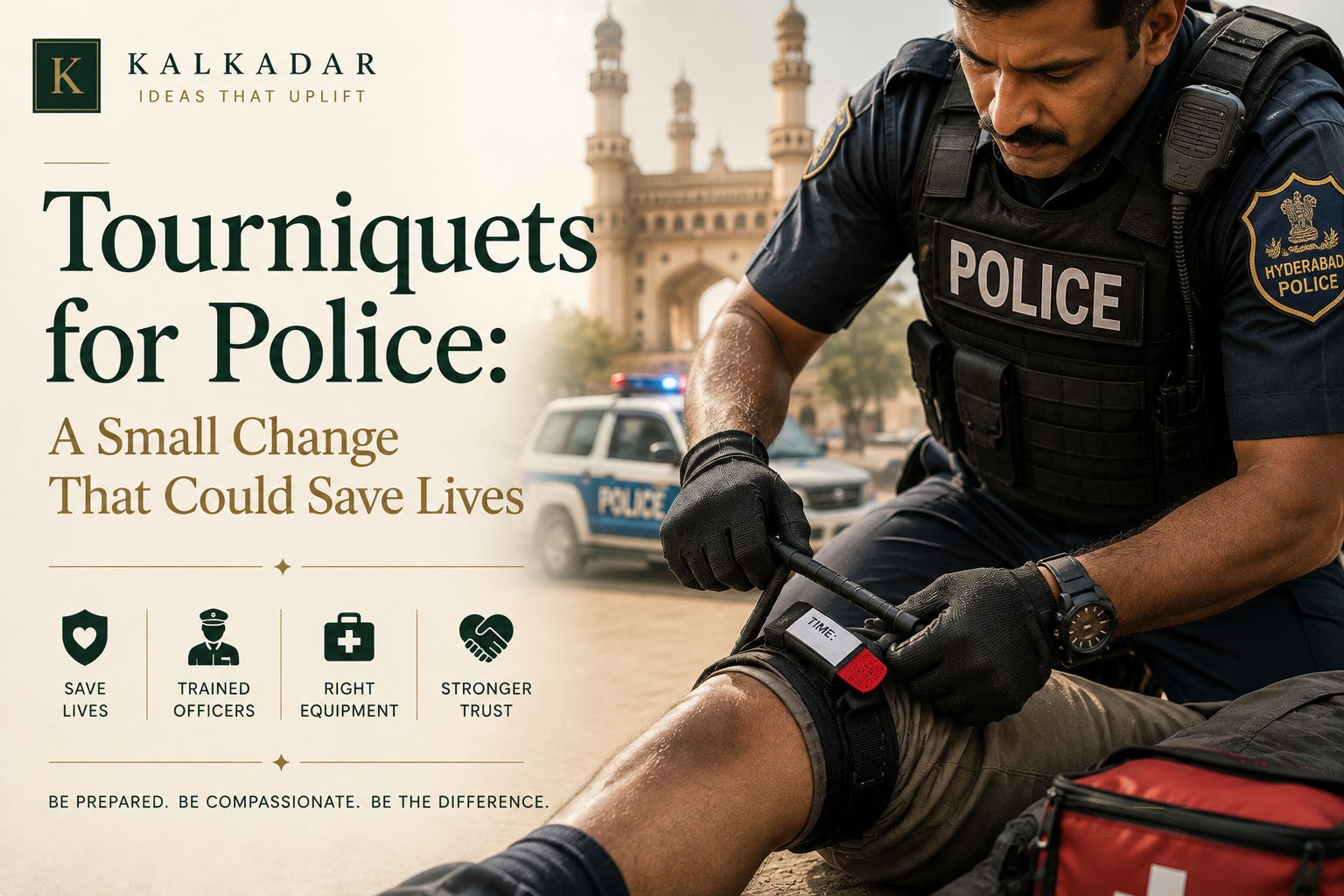
I first learned about the value of tourniquets by occasionally listening to podcasts featuring members of a nation’s special forces.
One idea stayed with me.
A simple piece of equipment, weighing only a few hundred grams and costing relatively little, can stop catastrophic bleeding and save a life within minutes.
That prompted me to think about policing.
Part of the reason is personal.
My childhood classmate, cricket teammate, and friend, is now the Director General of Police (Head of Police) of a state in India.
Knowing someone who has devoted his career to policing naturally leads me to think about practical ideas that might help officers serve the public even more effectively.
Every police service in the world could consider whether similar policies would benefit both officers and the communities they serve.
Police Often Arrive Before Ambulances
Every day, police officers are dispatched to:
road traffic collisions;
stabbings;
industrial accidents;
railway incidents;
violent assaults;
disasters;
and other emergencies.
Very often, they arrive before paramedics.
When someone has catastrophic bleeding from an arm or leg, every minute matters.
A properly applied commercial tourniquet can stop that bleeding long enough for the victim to reach hospital.
That is why many military organizations, emergency medical services, and an increasing number of civilian police agencies train officers to use them.
A Growing Number of Police Services Are Already Moving Forward
Police have invested significantly in cardiopulmonary resuscitation (CPR) and first-aid training.
Teaching catastrophic bleeding control would be a natural extension of that work.
CPR saves lives when the heart stops.
Tourniquets save lives when blood leaves the body.
Both are part of preserving life.
Start With Selected Officers
Rather than immediately issuing tourniquets to every police officer, a phased approach may be more practical.
Each police station could identify a number of officers to receive advanced bleeding-control training.
Those officers would carry commercial tourniquets while on duty and could respond whenever serious injuries are reported.
As experience grows, the programme could gradually expand to include more frontline personnel.
This approach keeps costs manageable, simplifies training, and allows procedures to be refined before wider implementation.
Benefits Beyond Saving Lives
The most obvious benefit is saving victims who would otherwise bleed to death before reaching hospital.
But there are others.
Police could save fellow officers injured in the line of duty.
They could help firefighters, municipal workers, accident victims, suspects, protesters, and ordinary members of the public.
Just as importantly, programmes like this change how the public sees policing.
People remember the officer who saved a life.
They remember compassion, professionalism, and competence.
Every successful rescue strengthens public confidence in policing.
Trust is built one interaction at a time.
Legitimate Concerns
Some readers will immediately think about police corruption, excessive force, and custodial violence.
Those concerns are legitimate and should never be dismissed.
Any equipment issued to police has the potential to be misused.
However, the answer is not to withhold lifesaving equipment.
The answer is to introduce it responsibly.
Every use of a tourniquet should be documented.
Medical staff should confirm whether its application was appropriate.
Whenever it is used on someone in police custody or during a police use-of-force incident, additional review should automatically occur.
Transparency protects both the public and honest police officers.
Training Matters More Than Equipment
Buying tourniquets alone achieves very little.
Officers must learn:
when a tourniquet is appropriate;
when direct pressure is sufficient;
how to apply it correctly;
how to recognise shock;
and how to transfer care safely to paramedics.
These are practical skills that require hands-on training and regular refresher exercises.
A Model Worth Considering Worldwide
The idea is universal.
Every police service should ask a simple question:
If our officers are often first on scene, should they have the training and equipment to save someone from bleeding to death?
Many agencies have already answered yes.
Others may wish to consider doing the same.
Conclusion
Modern policing is about far more than enforcing the law.
It is also about protecting life.
Equipping selected police officers with commercial tourniquets, supported by practical training, clear procedures, medical oversight, and strong accountability, would be a relatively inexpensive reform with the potential to save many lives.
Sometimes, the most meaningful improvements are not the most expensive or the most technologically advanced.
Sometimes they are simply the right tool, in the right hands, at the right time.
If you found this idea worthwhile, please share it.
It may help save a life.
Join readers exploring practical ideas for a better future.