


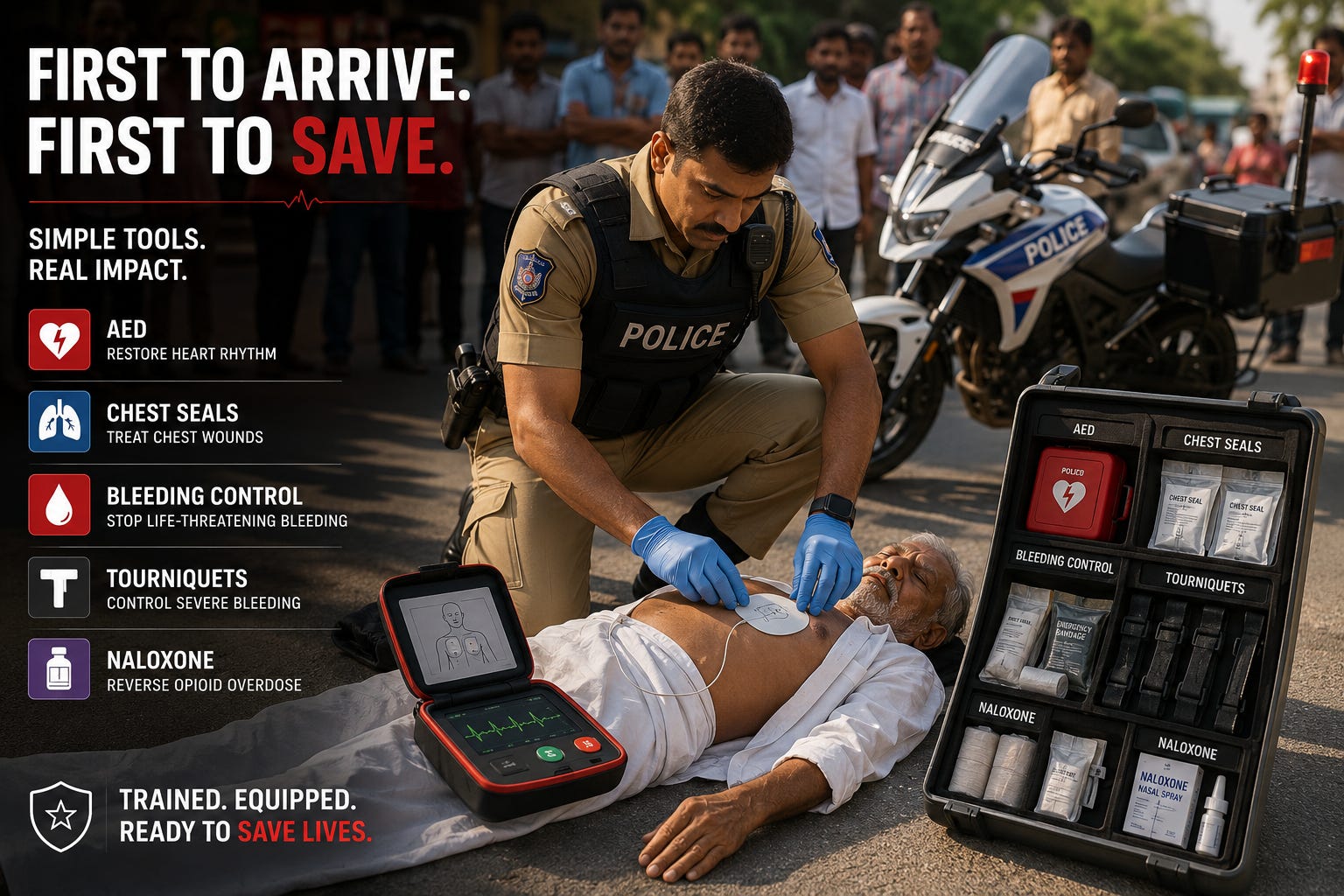
In my previous article, I proposed equipping selected police officers with tourniquets.
That raises a larger question: what other simple lifesaving interventions could police provide when they arrive before an ambulance?
Shootings, stabbings, motorcycle crashes, cardiac arrests, and other medical emergencies occur every day around the world.
But in many countries, especially across parts of Asia, Africa, and South America, the ambulance may not arrive quickly.
In some places, organized ambulance services are limited. In others, traffic, distance, resources, or sheer demand can make emergency medical response difficult.
Yet many of these same countries have a substantial police presence.
Police officers are distributed throughout cities and towns. Many patrol on motorcycles, allowing them to move through congested streets and potentially reach an emergency within minutes.
What if selected officers were trained and equipped not merely to enforce the law, but to keep someone alive until they could reach a hospital?
Four Tools That Could Save Lives
A carefully designed police first-response kit might include an automated external defibrillator (AED), chest seals, pressure dressings and bleeding-control equipment, tourniquets, and naloxone where opioid overdose is a significant local problem.
Much of this equipment is remarkably compact. Even an AED designed for mobile use can be relatively small. A carefully designed lifesaving kit could potentially fit into the storage box of a police motorcycle or easily into a patrol vehicle.
None of this means turning police officers into paramedics.
It means identifying a small number of interventions that properly trained officers could safely perform during the critical minutes before professional medical care becomes available.
AEDs
Some years ago, I saw a video of a prominent businessman in his sixties lying on the floor at a public gathering. He was still alive. People surrounded him, clearly wanting to help, but apparently unsure what to do.
It was later reported that he died following a heart attack.
I do not know whether an AED would have saved him. A heart attack and cardiac arrest are not the same thing.
But the scene stayed with me.
I once heard a prominent Western professor, then in his eighties, describe collapsing from cardiac arrest on a university campus when he was in his sixties.
Students responded. An AED was available. His heart was successfully defibrillated.
He survived and continued teaching for years.
That is the power of having the right equipment, in the right place, with people who know how to use it.
If someone suffers a shockable cardiac arrest, rapid CPR and defibrillation with an AED can sometimes mean the difference between life and death.
Chest Seals
A penetrating chest injury can create another rapidly developing emergency.
If air enters the space between the lung and chest wall, the lung can partially or completely collapse. In some cases, pressure can continue building inside the chest and become life-threatening.
An appropriate chest seal, used by someone properly trained and operating under a medically approved protocol, may help manage certain open chest wounds while the injured person is transported for definitive medical treatment.
Stopping Severe Bleeding
A person with catastrophic bleeding can deteriorate extraordinarily quickly.
This is where tourniquets, wound packing, pressure dressings, and other bleeding-control equipment can matter.
A trained responder who recognizes life-threatening bleeding and intervenes correctly may buy the victim something enormously valuable:
time.
Time to reach a surgeon.
Time to receive blood.
Time to survive.
Naloxone
Where opioid overdoses are common, naloxone could be another valuable tool.
Opioids such as fentanyl can suppress breathing until a person becomes unconscious and dies. Naloxone can temporarily reverse an opioid overdose, potentially restoring breathing long enough for the person to receive further medical care.
Naloxone is also remarkably compact. Where the local risk justifies carrying it, it could occupy very little space in a first-response kit.
Start Small, Then Measure
Countries with limited ambulance coverage could begin experimentally.
Equip selected police motorcycles and patrol vehicles with compact lifesaving kits. Train selected officers. Establish protocols with emergency physicians.
Then measure what happens.
How quickly did officers arrive? How often was the equipment used? Were there complications? Most importantly, did the interventions improve survival?
If the evidence supports the program, improve it and expand it.
Funding could begin with central or national governments, supplemented by state, provincial, territorial, or local governments according to each country’s governmental structure.
Eventually, there could be multiple trained first-response teams on every shift at every major police station across the nation.
Where the Idea Came From
There is already real-world experience behind this approach.
A retired U.S. based EMS leader and longtime paramedic read my earlier article about equipping police officers with tourniquets. In a comment on my LinkedIn post, she pointed out that the idea could go much further.
Her police department carries AEDs, naloxone, tourniquets, and chest seals, and she noted that these tools have been used over the years to save lives.
Her comment prompted me to explore the idea further.
I thought the broader concept was excellent. If these interventions are already saving lives in some communities, could similar models be adapted for countries where ambulance services are much more limited?
Her comment sparked this follow-up article.
A Cross-Pollination of Ideas
I was born and raised in Hyderabad, India. I have lived in Toronto, Canada, for decades and spent about half a decade in Madinah, Saudi Arabia. I have worked professionally in the security industry in Canada and have also trained and worked as a preacher. I remain in regular contact with people and events across these regions.
My mind naturally studies, analyzes, and cross-pollinates experiences and ideas from different societies.
Something that works in Toronto or the United States may not transfer directly to Hyderabad, Riyadh, Nairobi, Dhaka, or Lagos.
But many underlying ideas might.
The Police First Responder
The police officer who arrives first would still be a police officer.
But for a bleeding motorcyclist, a stabbing victim, a person in cardiac arrest, or someone dying from an overdose, that officer might also become something else for a few crucial minutes: the person who keeps them alive long enough to reach the hospital.
If you found this idea worthwhile, please share it.
It may help save a life.
Join readers exploring practical ideas for a better future.