


Before We Go Further
If you haven’t already done so, you may wish to read my two earlier articles on improving emergency preparedness and police response systems first:
Tourniquets for Police: A Small Change That Could Save Lives
When the Police Arrive Before the Ambulance
From Police to the Wider Community
In them, I argued that in countries where ambulance services are limited, selected police officers could be trained and equipped to provide a small number of lifesaving interventions before medical help arrives.
But police are only one part of the picture.
Governments in countries with limited emergency medical services should consider a broader question:
Where else should lifesaving equipment and trained people be available?
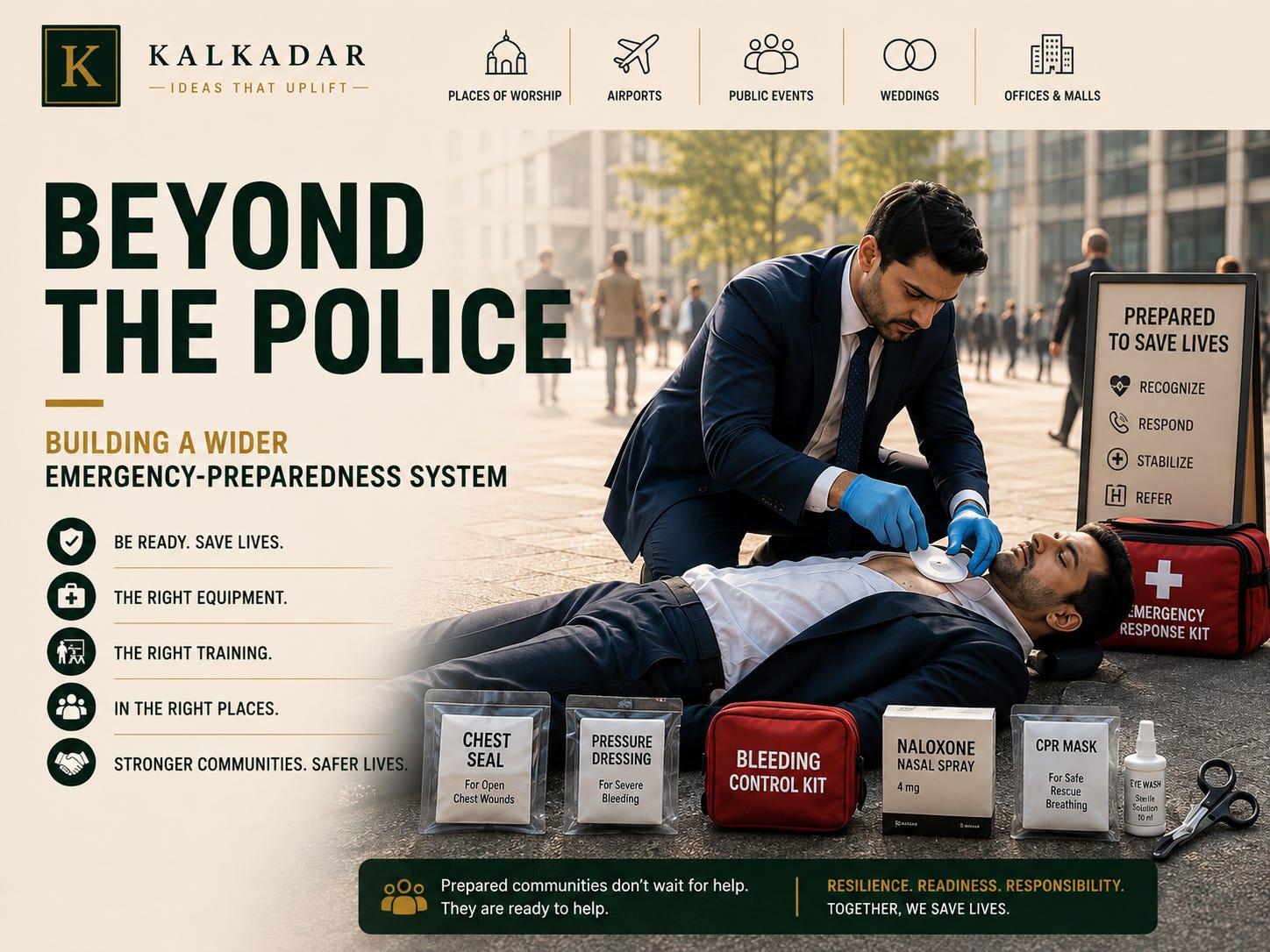
Stadiums. Airports. Large public events. Universities. Shopping malls. Office towers. Large residential compounds. Major places of worship. Wedding halls. Gyms.
What Should Be Available?
Depending on local risks and medical guidance, appropriate equipment might include automated external defibrillators (AEDs), tourniquets, pressure dressings and gauze, chest seals, naloxone, and other basic emergency supplies.
My earlier article, When the Police Arrive Before the Ambulance, briefly explains what each of these is, what it does, and the kinds of emergencies in which it may be useful.
Equipment Is Not Enough
Equipment alone, however, is not enough.
Governments could develop laws, regulations and licensing standards governing where such equipment should be required, who may use it, how people should be trained, how equipment should be maintained, and how these systems connect with hospitals and emergency services.
The requirements need not be identical everywhere.
An airport does not have the same risk profile as an apartment complex. A university does not have the same needs as a wedding hall. Naloxone may be important in one jurisdiction and far less relevant in another.
Local medical and emergency-response professionals should determine what is appropriate.
Where maintaining trained staff permanently on-site is impractical, regulations could require appropriately trained personnel to be hired for particular events, such as large public gatherings, weddings, conferences, or major religious gatherings.
The objective is not to turn security guards, gym employees or event workers into paramedics.
It is to improve the chances that when someone collapses, stops breathing, suffers catastrophic bleeding or experiences another time-critical emergency, the first few minutes are not simply lost.
A Layered Emergency-Preparedness System
Over time, something larger begins to emerge.
Selected police officers are trained and equipped.
Key private and nonprofit institutions have appropriate emergency equipment.
Large gatherings have trained personnel available.
Standards exist for training, maintenance and oversight.
A city gradually develops a layered emergency-preparedness system.
Beyond Saving Lives
The immediate benefit is a greater chance of saving lives and better managing injuries before professional medical care becomes available.
But there may be wider benefits too.
Visible emergency preparedness can strengthen public confidence, improve perceptions of institutional competence and contribute, at the margins, to making cities and countries more attractive places to visit, work, invest and live.
This is not a substitute for building reliable ambulance and emergency medical services.
It is one step toward them.
The Next Step
Once these individual pieces begin connecting, an even larger possibility appears.
That is where I will go in my next article.
If you found this idea worthwhile, please like and share this article with someone who may find it useful, and subscribe to Kalkadar to receive future articles by email.
Thank you for reading.
Towards a safer, healthier and better-prepared world.
AI disclosure:
The ideas, framing and arguments are my own.
I use a paid, advanced frontier AI model to help develop, check and polish my work through multiple iterations.
I review, edit and approve the final article.
The accompanying image was developed similarly.